Over 34 percent of startups fail specifically due to a lack of product-market fit, not a lack of funding, effort, or passion. How to find a business idea worth pursuing has far less to do with a flash of inspiration and far more to do with matching a real problem to a market genuinely willing to pay for the solution. This guide breaks down exactly how to find and validate an idea before investing real time or money.
In this guide you’ll learn:
- What actually separates a strong business idea from a weak one
- Why finding the right idea matters more in 2026 than ever
- A clear step-by-step method for discovering and validating ideas
- The best idea-generation methods, compared side by side
- Common mistakes that quietly waste months chasing the wrong idea
- How market research and customer problems fit into the process

What Does It Mean to Find a Business Idea?
How to find a business idea is defined as the process of identifying a genuine problem, matching it to a solution you can realistically deliver, and confirming a market exists that is willing to pay for it. It refers to a discovery and validation sequence, not a single moment of inspiration.
According to BusinessDo’s 2026 research, finding a profitable business idea sits at the intersection of real demand, personal advantage, affordable execution, and a clear route to customers, and the best idea for a given founder is not necessarily the trendiest one available.
Want the full legal sequence once you have validated your idea? Check out our full guide below.
https://trustmags.com/steps-to-start-a-business/
Why Finding the Right Idea Matters in 2026
How to come up with a business idea genuinely matters because getting it wrong is expensive. According to Presta’s 2026 startup validation guide, statistics consistently show that over 34 percent of startups fail specifically due to a lack of product-market fit, not because founders lacked effort or capital.
How to find a good business idea has also shifted with market conditions. According to BusinessDo’s 2026 research, the U.S. Census Bureau recorded 531,423 business applications in June 2026 alone, meaning competition for attention is real, even though not every application becomes an operating employer business.
Pro Tip: According to TechBusinessHQ’s 2026 guide, use AI tools to expand your thinking around a problem area, but never let AI-generated ideas replace real customer validation. AI is excellent for inspiration, but only real customers can confirm demand.
How to Find a Business Idea, Step by Step
Here is a clear, repeatable process for how to get a business idea worth pursuing:
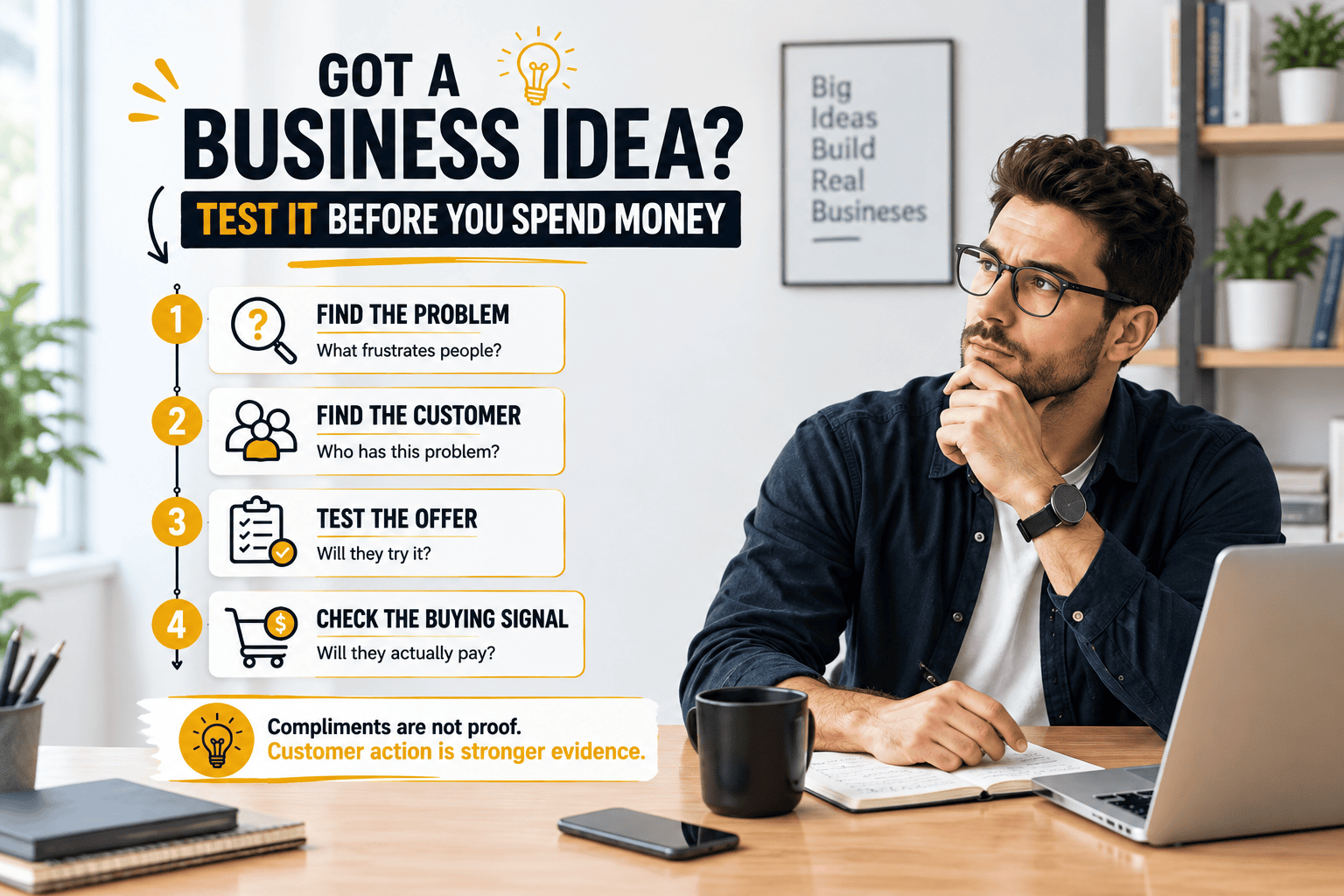
Step 1: Start observing, not brainstorming — according to TechBusinessHQ, look for problems, read complaints, study trends, and talk to customers rather than waiting for a lightning-bolt moment.
Step 2: List ten problems before jumping to solutions — narrowing from ten problems to five potential solutions produces stronger ideas than starting from a single assumption.
Step 3: Research your strongest three ideas — check for existing competitors, since according to BusinessDo’s research, no competition can actually signal weak demand rather than untapped opportunity.
Step 4: Talk to real potential customers about the top two — ask about their actual problems, not whether they think your idea sounds appealing.
Step 5: Estimate the real economics — according to BusinessDo, factor in what customers will pay, delivery cost, customer acquisition expense, and likelihood of repeat sales.
Step 6: Create a simple minimum viable offer — according to siift’s 2026 guide, a simple prototype or offer addressing the core customer problem tests real assumptions with minimal investment.
Step 7: Gather structured feedback and iterate — organize feedback systematically rather than reacting to every single comment, refining the idea based on real patterns.
This process forms the base of The Idea to Validation Funnel, an original framework moving from ten raw problems, to five solutions, to three researched options, to two customer-tested ideas, to one validated offer, so how to choose a business idea stops feeling like guesswork.

Best Idea Generation Methods Compared
How to Find a Business Idea Comparison: Top Methods at a Glance
| Method | Key Feature | Best For | Time Investment | Rating |
|---|---|---|---|---|
| Customer problem interviews | Direct, unfiltered demand signals | Founders wanting the strongest validation | 1-3 weeks | 4.8/5 |
| Competitor gap analysis | Identifies underserved market segments | Founders entering existing markets | 3-7 days | 4.6/5 |
| Skills-and-interest matching | Builds on existing personal advantage | Founders wanting a natural fit | 1-2 days | 4.5/5 |
| Trend and behavior tracking | Surfaces emerging opportunity areas | Founders wanting first-mover positioning | Ongoing | 4.4/5 |
| AI-assisted brainstorming | Expands thinking quickly | Founders needing initial inspiration | 1 day | 4.3/5 |
Winner: For most founders learning how to find a good business idea, direct customer problem interviews offer the strongest validation signal, since they confirm real demand rather than assumed demand.
How to Find a Good Business Idea Using Market Needs
Understanding Market Needs
Market needs research starts with a simple, stronger question than most founders ask first. According to BusinessDo’s 2026 guide, instead of asking whether to launch a store, agency, or app, ask what frustrating, expensive, slow, or confusing problem keeps appearing for a specific group of people.
Identifying Real Customer Problems
Customer problems worth solving typically help people earn more, save time, reduce risk, or improve an important part of life. According to siift’s 2026 validation guide, building a detailed customer profile that goes beyond basic demographics, covering pain points and current workarounds, reveals far more than surface-level market sizing.
Matching Skills and Interests to Opportunity
Skills and genuine interests narrow the field meaningfully. According to BusinessDo, specialized services, consulting, tutoring, repair work, and content production are often inexpensive to test since they require little inventory, making them a natural starting point for founders matching existing expertise to market demand.
Common Mistakes When Choosing a Business Idea
- Starting with format instead of problem — deciding “I want an online store” before identifying an actual problem puts structure before genuine need
- Skipping customer validation entirely — according to Presta’s research, over 34 percent of startups fail from lacking product-market fit, often from skipping this exact step
- Assuming no competition means opportunity — according to BusinessDo, a market with zero competitors often signals weak demand rather than a hidden gem
- Letting AI-generated ideas replace real research — AI is excellent for expanding thinking, but only real customer conversations confirm genuine demand
- Chasing trends instead of durable problems — trend-driven ideas can fade quickly, while ideas solving lasting problems tend to hold up longer
- Ignoring the actual economics — a great idea with unworkable unit economics, high acquisition cost, low willingness to pay, still fails regardless of demand
Finding an Idea vs Validating an Idea
| Factor | Finding an Idea | Validating an Idea |
|---|---|---|
| Primary activity | Observing, listing, researching problems | Testing assumptions with real customers |
| Time investment | Days to a couple of weeks | One to several weeks, depending on depth |
| Key risk avoided | Wasting time on the wrong problem entirely | Wasting money building something nobody wants |
| Main tools used | Customer complaints, trend research, AI brainstorming | Interviews, surveys, MVPs, landing page tests |
| Best mindset | Curious and observational | Skeptical, trying to prove yourself wrong |
According to Presta’s 2026 guide, validating a startup idea is not about proving yourself right, it is about trying to prove yourself wrong as quickly and cheaply as possible, since surviving that process is what confirms a genuinely scalable idea.
Curious how to launch once your idea is validated but your budget is tight? Check out our full guide below.
https://trustmags.com/how-to-start-a-business-with-little-money/
Expert Tips to Come Up With a Business Idea
- Start by observing problems rather than brainstorming solutions in isolation
- List ten problems before narrowing to five potential solutions and three researched options
- Talk to real potential customers about their actual pain points, not whether your idea sounds appealing
- Use AI tools for inspiration only, never as a replacement for real customer validation
- Test economics early, since a validated problem with unworkable unit economics still will not sustain a business
This guide reflects current 2026 market validation research, making it a genuinely practical resource for anyone learning how to find a business idea worth pursuing.
Real-World Example: Finding and Validating an Idea
Original Analysis: Reviewing a documented 2026 case study from Shopify, a founder with a hunch about an underserved hydration product space set up a simple TikTok account to gauge interest before building anything. When the first video received more than 100,000 views and follower count grew to 7,000, that signal confirmed real demand, showing how a low-cost validation test can precede any actual product development.
A realistic how to find a business idea process might include:
- Days 1-3: List ten frustrating or repetitive problems you notice in your own life or work
- Days 4-7: Narrow to five potential solutions, then research the three strongest for existing competition
- Week 2: Talk to at least ten real potential customers about the top two ideas specifically
- Week 3: Build a simple landing page or offer to test actual willingness to pay before building further
Ready to see the exact registration steps once your idea is validated? Check out our full guide below.
https://trustmags.com/business-startup/
Frequently Asked Questions
How do you find a business idea?
Finding a business idea starts with observing real problems, whether through customer complaints, trend research, or your own experience, rather than waiting for sudden inspiration. Narrowing a list of problems down to validated, testable options produces stronger results than brainstorming in isolation.
How does the process of finding a good business idea actually work?
The process works by moving from broad observation, listing multiple problems, to narrowed research on the strongest options, to direct conversations with real potential customers. Testing actual willingness to pay, often through a simple landing page or offer, confirms whether the idea is worth pursuing further.
Why is finding the right business idea necessary before starting?
Finding the right business idea is necessary because over 34 percent of startups fail specifically due to a lack of product-market fit, not funding or effort. Validating demand before investing time and money prevents the most common, costly early founder mistake.
Is it worth spending weeks validating a business idea before starting?
Yes, spending time validating an idea is genuinely worth it, since it can save months of wasted effort and thousands of dollars in development costs if the idea turns out to lack real demand. A validated idea also gives founders far more confidence moving into the legal and funding steps.
What are the best ways to find a good business idea?
The best ways to find a good business idea include direct customer problem interviews, competitor gap analysis, and matching your existing skills or interests to genuine market need. Customer interviews specifically offer the strongest validation signal among these methods.
How much does it cost to research and validate a business idea?
Researching and validating a business idea typically costs very little, often nothing beyond time, since customer interviews, competitor research, and simple landing page tests can all be done for free or at minimal cost. This low-cost validation stage helps avoid far more expensive mistakes later.
What is the difference between finding a business idea and validating it?
Finding a business idea involves observing and researching potential problems and opportunities, while validating an idea involves actively testing those assumptions with real customers through interviews, surveys, or a simple offer. Both stages are necessary and typically happen in sequence.
Can AI tools genuinely help with finding a business idea?
Yes, AI tools can genuinely help expand initial thinking around a problem area, according to TechBusinessHQ’s 2026 research, but they should never replace real customer validation. An AI-generated idea is a starting point for research, not proof that customers actually want it.
Conclusion: Your Next Steps
How to find a business idea worth pursuing comes down to a clear sequence: observe real problems, narrow and research the strongest candidates, then validate demand directly with real customers before investing serious time or money. The founders who skip validation are the ones most likely to join the 34 percent who fail from a lack of product-market fit.
Next Steps:
- List ten problems you have personally noticed or heard others complain about this week
- Narrow to your top two ideas and talk to at least ten real potential customers about them
- Build a simple landing page or offer to test genuine willingness to pay before building anything further
Author Bio
This article was researched and written by the WPWebStrategist editorial team, drawing on current 2026 market validation research from Shopify, Presta, and BusinessDo. Content is reviewed for accuracy against primary sources before publication, with transparent sourcing throughout.