More than half of small businesses now use AI somewhere in their operations, according to a Q4 2025 report from OnDeck and Ocrolus, and that shift alone is changing what it actually takes to succeed. How to start a business in 2026 is not the same process it was even three years ago, but the fundamentals, validating an idea, choosing a structure, and finding real customers, have not gone anywhere. This guide walks through the complete process, step by step, with real costs and timelines included.
In this guide you’ll learn:
- What actually separates a successful business launch from a failed one
- Why starting a business the right way matters more in 2026 than ever
- A clear, ten-step process for going from idea to open for business
- The best business structures compared, with real costs and tradeoffs
- Common mistakes that quietly sink new businesses in the first year
- How starting with little money changes the process

What Does It Mean to Start a Business?
How to start a business is defined as the process of turning a validated idea into a legally structured, operating venture that generates revenue, covering everything from idea validation and legal formation to funding, branding, and finding your first customers. It refers to a repeatable sequence, not a single decision made on day one.
According to ZenBusiness’s 2026 startup guide, a strong business plan needs to clearly cover company description, market analysis, business structure, and a marketing and sales plan, since these four elements form the foundation examiners, lenders, and investors all expect to see.
Want to explore ways to start a business without much upfront capital? Check out our full guide below.
https://trustmags.com/how-to-start-a-business-with-little-money/
Why Starting a Business Matters in 2026
Starting a business in 2026 looks meaningfully different from even a few years ago. According to Homebase’s 2026 small business report, more than half of small businesses now report using AI in their operations, from automated scheduling and invoicing to AI-assisted marketing, which is raising the ceiling for what a one or two person operation can accomplish.
Starting your own business also carries real workforce pressure right now. According to NFIB’s 2026 Jobs Reports, nearly a third of small business owners currently have job openings they cannot fill, which changes how founders need to think about automation, delegation, and realistic growth pacing from day one.
Pro Tip: According to GoDaddy’s 2026 business guide, the right time to start a business is when you have a validated market opportunity, ideally 6 to 12 months of financial runway, relevant skills, and enough passion to push through the inevitable early setbacks.
How to Start a Business, Step by Step
Here is a clear, repeatable process for how to start a business of your own in 2026:
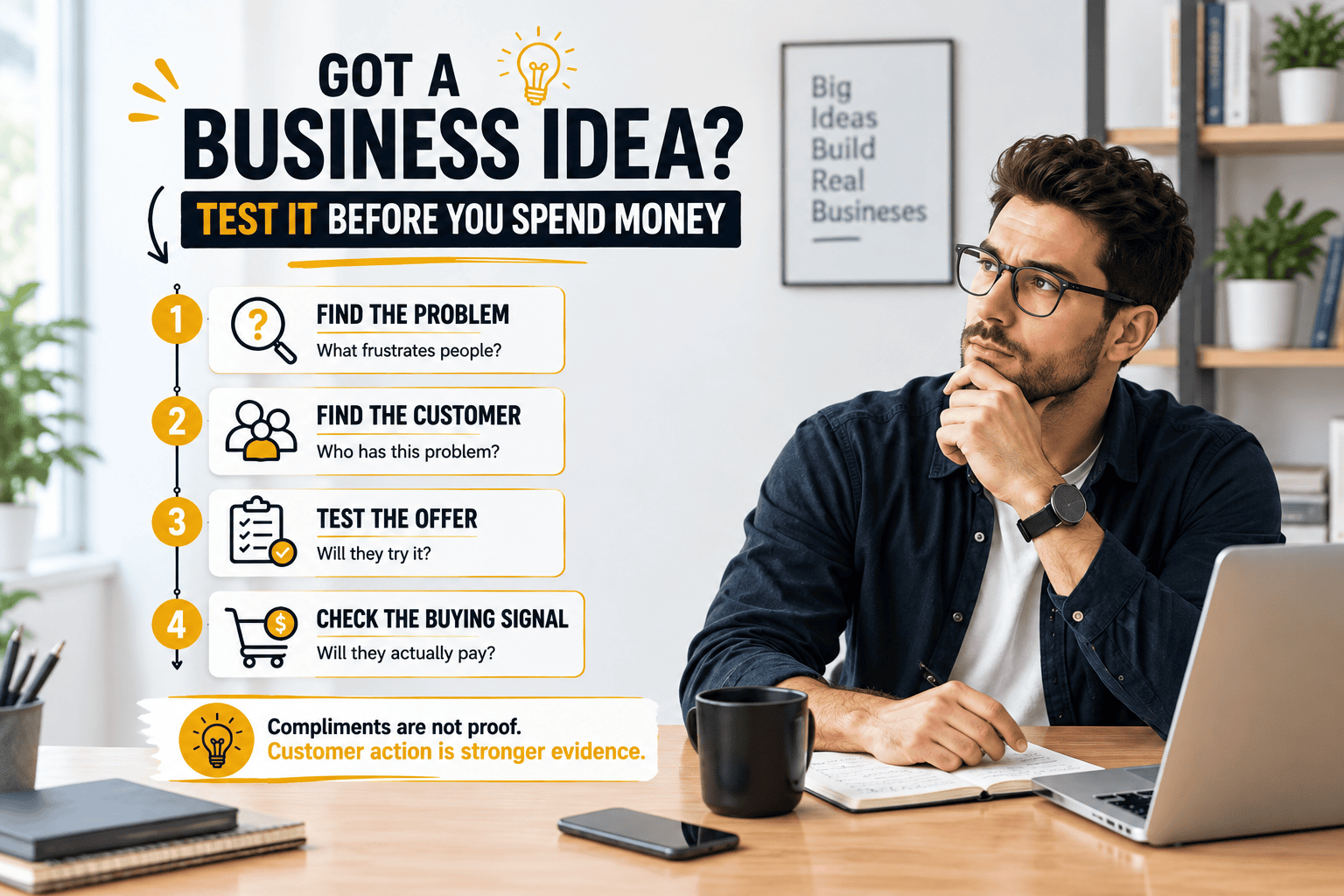
Step 1: Validate your business idea — talk to at least 10 potential customers before building anything, confirming real demand exists before investing time or money.
Step 2: Write a lean business plan — cover company description, market analysis, business structure, and a marketing and sales plan, using SBA’s free business plan tool as a starting template.
Step 3: Choose your business structure — sole proprietorship, LLC, or corporation each carry different liability protection, tax treatment, and setup cost.
Step 4: Register your business and get an EIN — file your formation document with your state, then get a free Employer Identification Number from the IRS.
Step 5: Handle licenses, permits, and a business bank account — requirements vary heavily by state and industry, so check your specific state’s business registration site.
Step 6: Build your brand basics — a business name, simple logo, consistent color palette, and a registered domain name, even before your website is fully ready.
Step 7: Set up your online presence — for local and brick-and-mortar businesses, a complete Google Business Profile is one of the single most impactful free marketing moves available.
Step 8: Choose your funding approach — personal savings, SBA-backed loans, angel investment, or small business grants are the primary funding paths most founders use in 2026.
Step 9: Launch with two or three consistent marketing channels — pick channels where your actual customers spend time, and work them consistently rather than spreading thin across many platforms.
Step 10: Nurture your first customers into advocates — personalized follow-up and consistent communication turn early customers into the word-of-mouth engine that carries most new businesses through their first year.
This process forms the base of The Ten-Step Launch Ladder, an original framework moving founders from validation, through legal formation, to funding, and finally to consistent customer acquisition, so how to start a business stops feeling overwhelming and starts feeling sequential.
Best Business Structures Compared
Business Structure Comparison: Top Options at a Glance
| Option | Key Feature | Best For | Price/Cost | Rating |
|---|---|---|---|---|
| Sole Proprietorship | No formal registration required | Freelancers, solo side businesses | $0 | 4.3/5 |
| LLC | Personal liability protection | Most small businesses, the most popular choice | $50-500 (state fee) | 4.8/5 |
| S-Corp | Tax savings on self-employment income | Growing businesses with steady profit | $500-1,500 | 4.5/5 |
| C-Corp | Best for raising venture capital | Startups planning to scale and raise funding | $500-1,500+ | 4.4/5 |
| Partnership | Shared ownership and responsibility | Two or more co-founders | $0-300 | 4.2/5 |
Winner: For most people learning how to start a small business, an LLC offers the strongest balance of liability protection, manageable cost, and flexible tax treatment, which is why it remains the most popular structure nationwide.
How to Find a Business Idea Worth Pursuing
A genuinely strong business idea solves an existing problem in a market you already understand, rather than chasing whatever trend is currently popular. According to Homebase’s 2026 research, service businesses like cleaning, landscaping, food trucks, and home repair tend to carry lower startup costs and immediate local demand, while retail and food businesses can scale faster but require more upfront capital.
Four Categories Worth Considering
- Service businesses — lower startup costs, immediate local demand, examples include cleaning, landscaping, and home repair
- Retail and food businesses — faster scaling potential, but require more capital upfront
- Online and home-based businesses — lower overhead, but need a clear customer acquisition plan from day one
- Skill-based freelance or consulting businesses — minimal startup cost, built directly on existing expertise
Curious about a deeper dive into idea generation specifically? Check out our full guide below.
https://trustmags.com/how-to-find-a-business-idea/
Common Mistakes When Starting a Business
- Skipping customer validation entirely — building a product or service before confirming real demand wastes the most valuable early resource, time
- Choosing the wrong business structure for growth plans — a sole proprietorship without liability protection can expose personal assets unnecessarily
- Underestimating startup costs — according to StartupOwl’s 2026 data, total costs range from 0 to 1,500 dollars depending on state and entity type, but many founders forget ongoing costs like licenses and taxes
- Spreading thin across too many marketing channels — consistency on two or three channels outperforms scattered effort across five or six
- Ignoring the Google Business Profile for local businesses — this free listing is one of the most impactful visibility tools available, and skipping it costs real customers
- Not setting aside money for taxes — self-employed founders should set aside 25 to 30 percent of profit for quarterly estimated taxes to avoid IRS penalties
Starting a Business vs Buying an Existing One
| Factor | Starting a New Business | Buying an Existing Business |
|---|---|---|
| Upfront cost | Lower initial investment | Higher purchase price, but includes existing revenue |
| Time to revenue | Slower, builds from zero | Faster, existing customer base already in place |
| Brand control | Full creative and strategic control | Limited by existing brand and reputation |
| Risk profile | Higher uncertainty, unproven concept | Lower uncertainty, proven track record |
| Best for | Founders with a clear original vision | Founders wanting faster cash flow with less brand-building |
Both paths can work well depending on available capital and risk tolerance, and many successful entrepreneurs choose buying an existing business specifically to skip the slowest, most uncertain early growth phase.
Expert Tips to Start a Business Successfully
- Talk to real potential customers before building anything, validation prevents the most common early failure
- Use SBA’s free business plan tool and market research resources rather than starting from a blank page
- Set aside 6 to 12 months of financial runway before launching, according to GoDaddy’s 2026 guidance
- Complete your Google Business Profile fully, with accurate hours and real photos, if you serve local customers
- Treat your first customers as brand advocates, and follow up personally rather than treating the sale as the finish line
This guide reflects current 2026 small business research from SBA, NFIB, and leading business formation services, making it a genuinely practical resource for anyone learning how to start a business.
Real-World Business Startup Examples
Original Analysis: Reviewing common founder timelines across current 2026 startup guides, the most consistent success pattern followed roughly this sequence: two to four weeks validating the idea through direct customer conversations, one to two weeks handling legal formation and an EIN, then an immediate, consistent push across two marketing channels rather than a slow multi-channel rollout, a pattern that shows up repeatedly across founder case studies regardless of industry.
A realistic business startup timeline might include:
- Weeks 1-2: Validate the idea by talking to at least 10 potential customers
- Weeks 3-4: Choose a business structure, register, and get an EIN
- Week 5: Set up a business bank account, basic branding, and a Google Business Profile
- Weeks 6-8: Launch with two consistent marketing channels and gather first customer feedback
- Month 3 onward: Reinvest early revenue into the channel that is actually working
Ready for the exact legal and financial steps in more detail? Check out our full guide below.
https://trustmags.com/steps-to-start-a-business/
Starting with limited capital changes several of these steps significantly. Check out our full guide below.
https://trustmags.com/how-to-start-a-business-with-little-money/
Frequently Asked Questions
How to start a business from scratch?
Starting a business from scratch begins with validating your idea against real customer demand, then choosing a business structure, registering with your state, and getting a free EIN from the IRS. From there, branding, a business bank account, and consistent marketing complete the launch process.
How does starting a business work legally?
Starting a business legally works by filing a formation document with your state, appointing a registered agent if required, obtaining an EIN, and securing any industry-specific licenses or permits. Requirements vary by state, so checking your specific state’s business registration site is essential.
Why is learning how to start a business necessary these days?
Learning how to start a business has become increasingly necessary as more than half of small businesses now use AI in daily operations, changing what a lean, one or two person team can realistically accomplish. Understanding the current process helps founders avoid costly early mistakes.
Is starting a business worth it in 2026 specifically?
Starting a business is genuinely worth it for founders with a validated idea, adequate financial runway, and relevant skills, according to GoDaddy’s 2026 guidance. Success depends far more on preparation and persistence than on perfect timing or market conditions.
What are the best business structures for beginners?
The best business structure for most beginners is an LLC, since it offers personal liability protection at a manageable cost, typically 50 to 500 dollars depending on the state. Sole proprietorships cost nothing but offer zero liability protection.
How much does it cost to start a business?
Starting a business typically costs between 0 and 1,500 dollars depending on state and entity type, according to StartupOwl’s 2026 research, with sole proprietorships costing nothing and LLC or corporation filings costing more. Ongoing costs like licenses and taxes should also be budgeted for.
What is the difference between an LLC and a sole proprietorship?
An LLC provides personal liability protection, separating personal assets from business debts, while a sole proprietorship offers no such protection but requires zero formal registration. Most growing small businesses eventually choose an LLC specifically for this liability protection.
Can starting a business help build long-term financial independence?
Yes, starting a business can meaningfully support long-term financial independence, though it requires serious commitment and realistic planning. According to SLT Creative’s 2026 research, successful founders treat their business as one of the most direct, though demanding, paths toward that independence.
Conclusion: Your Next Steps
How to start a business in 2026 ultimately comes down to ten sequential steps, from validating your idea to nurturing your first customers into advocates. The businesses that succeed are rarely the ones with the most funding, they are the ones that validate demand early, choose the right legal structure, and stay consistent with a focused marketing approach.
Next Steps:
- Talk to at least 10 potential customers this month to validate your business idea before building anything
- Choose your business structure and file for an EIN using SBA’s free resources
- Pick two marketing channels where your target customers actually spend time, and commit to consistency over the next 90 days
Author Bio
This article was researched and written by the WPWebStrategist editorial team, drawing on current 2026 research from the SBA, NFIB, and leading business formation services including ZenBusiness and GoDaddy. Content is reviewed for accuracy against primary sources before publication, with transparent sourcing throughout.