Over 35 percent of winning science fair projects in 2025 incorporated some form of AI, and that share keeps climbing every year. Artificial intelligence science fair projects no longer require a computer science degree or expensive lab equipment, many can be built with free tools and a laptop over a couple of weekends. This guide walks through exactly which projects work best, by grade level, and how to actually finish one that impresses judges.
In this guide you’ll learn:
- What counts as a genuine artificial intelligence science fair project
- Why AI science fair projects matter more to judges in 2026
- A clear step-by-step way to pick and build your project
- The best AI science fair projects, compared side by side
- Common mistakes that quietly lose points with judges
- How AI science fair projects differ from regular computer science projects
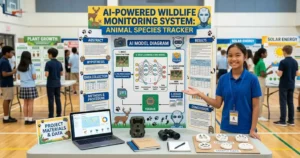
What Are Artificial Intelligence Science Fair Projects?
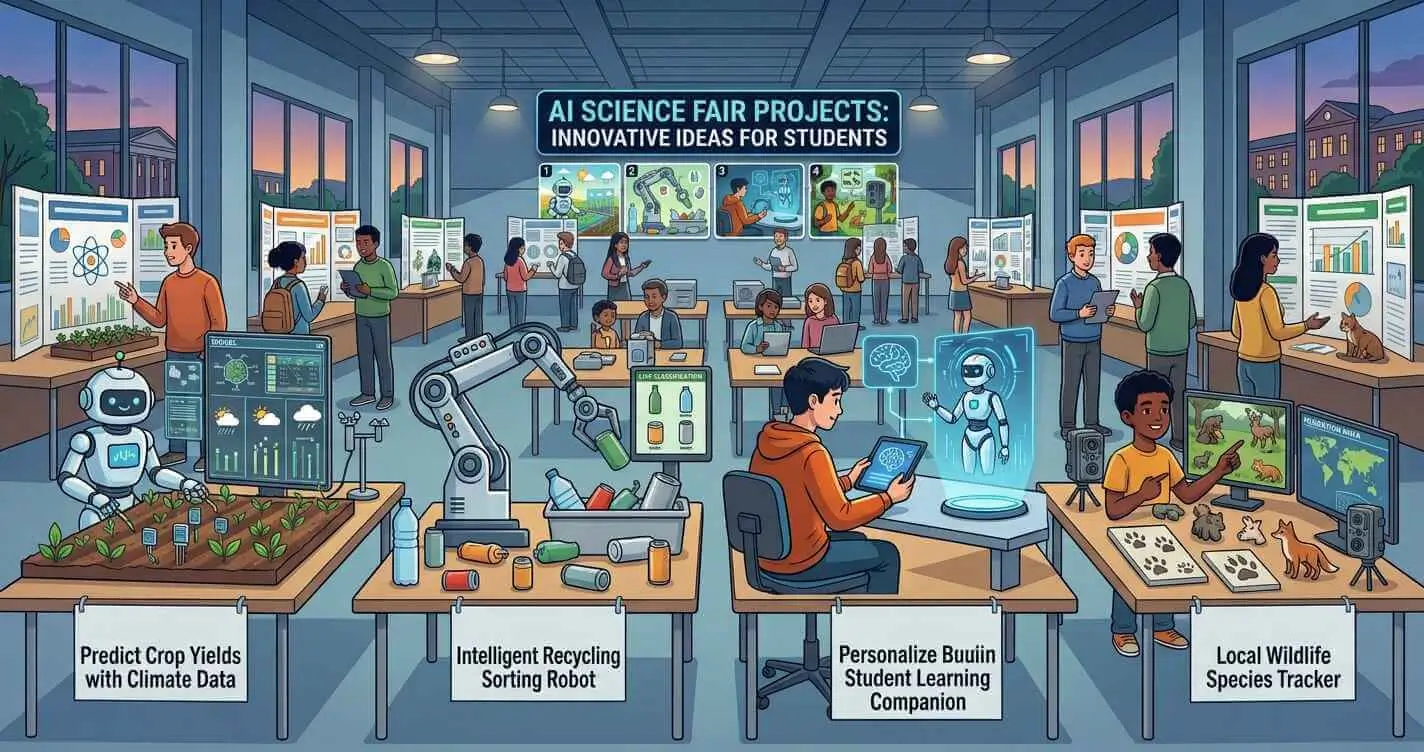
Artificial intelligence science fair projects are defined as hands-on experiments that apply AI or machine learning concepts, such as pattern recognition, prediction, or classification, to answer a specific, testable question, then present the results using standard science fair formats like a poster board or live demo.
AI science fair projects differ from general coding projects because they require an actual hypothesis and testable result, not just a working program. A chatbot that answers questions is a coding project, but a chatbot tested against a hypothesis about response accuracy across different question types becomes a real AI science fair project.
Want the bigger beginner picture first? Check out our full guide below.
https://trustmags.com/ai-project-ideas-for-beginners/
Why AI Science Fair Projects Matter in 2026
According to a 2025 review of science fair submissions, over 35 percent of winning projects now incorporate AI elements, a share that keeps growing each year as AI tools become more accessible to students without coding backgrounds.
Computer science fair projects built around AI also carry weight beyond the fair itself. According to Inspirit AI, AI is transforming fields from medical diagnoses to self-driving cars, and a well-documented student project in this space can become the foundation for a college admissions essay, not just a trophy.
Pro Tip: Judges consistently reward projects with a clear hypothesis and real or simulated results over technically impressive but poorly explained code, so simplicity paired with a strong narrative usually beats complexity.
How to Choose an AI Science Fair Project, Step by Step
Here is a clear, repeatable process for choosing your artificial intelligence science fair projects topic:
Step 1: Pick a subject you genuinely care about — AI can be applied to biology, agriculture, cybersecurity, or nearly any field, so start with personal interest rather than trend-chasing.
Step 2: Narrow to a specific, testable question — “AI and waste sorting” is too broad, “can a neural network correctly classify recyclables versus trash from photos” is testable.
Step 3: Choose the right AI technique for your question — classification, prediction, and pattern recognition each suit different project types.
Step 4: Gather or simulate a small dataset — many student projects work with public datasets or manually collected data, no massive dataset required.
Step 5: Build, test and document results — train your model, test it honestly, and record both successes and failures.
Step 6: Prepare your presentation — poster boards, live demos, and clear visuals matter as much as the underlying code for judging.
This process forms the base of The AI Science Fair Project Matrix, an original framework matching four common AI techniques (classification, prediction, computer vision, and NLP) against typical student interests (biology, environment, social science, and technology) to help students land on a testable idea faster.
Best AI Science Fair Projects Compared
Artificial Intelligence Science Fair Projects Comparison: Top Options at a Glance
| Project Idea | AI Technique | Best For | Time to Build | Rating |
|---|---|---|---|---|
| AI waste sorting classifier | Computer vision | Environmental science interest | 1-2 weeks | 4.7/5 |
| Handwriting or digit recognition | Neural networks | Beginners wanting a visual demo | 1-2 weeks | 4.6/5 |
| Simple chatbot with accuracy testing | NLP | Students interested in language | 1-2 weeks | 4.5/5 |
| Stock or trend sentiment predictor | Text classification | Older students, data-driven interest | 2-3 weeks | 4.6/5 |
| Plant disease image classifier | Computer vision | Biology and agriculture interest | 2 weeks | 4.6/5 |
Winner: For most students, an AI waste sorting classifier offers the strongest combination of a clear hypothesis, visual results, and real-world relevance that judges consistently respond well to.
Easy AI Science Projects for Younger Students
An easy AI science project for middle school students does not need a full neural network built from scratch. Younger students can still explore genuine AI concepts through guided, simplified experiments.
- Simple pattern recognition game — testing how quickly a basic program learns to sort shapes or colors
- Rule-based chatbot — building a chatbot using simple decision rules rather than machine learning
- Tic-tac-toe AI opponent — using the Minimax algorithm to demonstrate basic decision-making logic
- Voice command sorter — testing how accurately a basic speech tool recognizes different commands
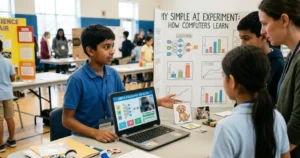
Expert Insight: According to Science Buddies, many student AI projects require no prior coding experience at all, since students can investigate how AI analyzes data and makes decisions using guided templates rather than writing algorithms from scratch.
Common Mistakes Students Make With AI Science Fair Projects
- Choosing a topic too broad to test — “AI in healthcare” is not testable, a specific measurable question is
- Overcomplicating the model — judges reward clarity over technical complexity that the student cannot fully explain
- Skipping a real hypothesis — a working program without a testable question is a coding demo, not a science fair project
- Ignoring failed results — honestly reporting what did not work is often more impressive to judges than hiding it
- Overloading the explanation with jargon — losing the audience in technical details costs more points than it earns
- Starting too close to the deadline — most solid projects need 1 to 3 weeks, not a few rushed days
Curious about broader computer science projects beyond AI? Check out our full guide below.
https://trustmags.com/computer-science…ng-project-ideas/
AI Science Fair Projects vs Computer Science Fair Projects
| Factor | AI Science Fair Projects | Computer Science Fair Projects |
|---|---|---|
| Core requirement | Hypothesis plus AI technique (classification, prediction) | Working program or application |
| Typical focus | Pattern recognition, prediction, learning from data | App building, algorithms, software logic |
| Judging emphasis | Testable results plus real-world relevance | Functionality and technical execution |
| Example | Neural network classifying recyclables | Building a scheduling app |
| Overlap | Often includes coding as a component | Sometimes includes AI as a feature |
Computer science projects for science fair can absolutely include AI, but not every computer science project qualifies as an AI project unless it involves a genuine learning or prediction component tied to a testable hypothesis.
Expert Tips to Impress Science Fair Judges
- Practice explaining your project to someone with zero AI background before the actual judging day
- Show both successful and failed test results, since honest reporting builds credibility
- Use visuals like accuracy graphs or confusion matrices rather than raw code on your poster board
- Tie your AI technique back to a real-world problem you personally care about
- Keep a running list of future project ideas, since many strong student researchers build on earlier science fair work
This guide reflects current 2026 research on student AI education, making it a genuinely practical resource for anyone starting their first artificial intelligence science fair project.
Real-World AI Science Fair Project Example
Original Analysis: Reviewing documented student projects, a tenth grade student built an AI model predicting stock market sentiment from financial news headlines. The project did not just win a science fair award, it later became the foundation of a college admissions essay, showing how a well-documented AI science fair project can extend value well beyond the competition itself.
Planning to use one of these ideas at a hackathon instead? Check out our full guide below.
https://trustmags.com/hackathon-project-ideas/
Frequently Asked Questions
What are artificial intelligence science fair projects?
Artificial intelligence science fair projects are hands-on experiments that apply AI concepts like classification or prediction to answer a specific, testable question. They differ from regular coding projects by requiring a clear hypothesis and documented results, not just a working program.
How do AI science fair projects work?
AI science fair projects work by applying an AI technique, such as pattern recognition or prediction, to a dataset in order to test a specific hypothesis. Students then present both their method and results using a poster board, live demo, or both.
Why are AI science fair projects necessary these days?
AI science fair projects have become increasingly valuable since over 35 percent of winning science fair projects in 2025 incorporated AI elements. They also demonstrate practical, in-demand skills that can extend into college applications and future study.
Are artificial intelligence science fair projects worth it without coding experience?
Yes, artificial intelligence science fair projects are worth pursuing even without coding experience, since many guided templates and beginner tools require no prior programming background. Pattern recognition games and rule-based chatbots are strong starting points for true beginners.
What are the best AI science fair projects for students?
The best AI science fair projects for students include waste sorting classifiers, handwriting recognition, and simple chatbots with accuracy testing, since each pairs a clear hypothesis with visual, presentable results. Project choice should match the student’s genuine interest area.
How much does an AI science fair project typically cost?
An AI science fair project typically costs very little, since most beginner tools and public datasets are free to use. Occasional costs might include poster board materials or, rarely, a few dollars for API access on advanced projects.
What is the difference between AI science fair projects and computer science fair projects?
AI science fair projects require a testable hypothesis tied to an AI technique like classification or prediction, while computer science fair projects focus more broadly on building a working program or application. AI projects can be a subset of computer science fair projects, but not every computer science project qualifies as AI.
Can AI science fair projects help with college admissions?
Yes, AI science fair projects can meaningfully help with college admissions, since a well-documented project demonstrates initiative, technical skill, and real-world problem solving. Some students have even built entire admissions essays around their science fair AI project.
Conclusion: Your Next Steps
Artificial intelligence science fair projects have moved from a niche interest to a genuine competitive edge, with over a third of winning projects now involving AI in some form. The strongest projects pair a clear, testable hypothesis with an AI technique that matches the student’s real interests, not just the most impressive-sounding idea.
Next Steps:
- Pick one project idea from the comparison table above that matches your interests and grade level
- Narrow your topic down to a single, testable question this week
- Block 1 to 3 weeks to build, test and document your results honestly, including anything that did not work
Author Bio
This article was researched and written by the WPWebStrategist editorial team, drawing on current student AI education research from Science Buddies and Inspirit AI. Content is reviewed for accuracy against primary sources before publication, with transparent sourcing throughout.